In convoy to Samarra
A few kilometers before the Jordanian / Iraqi border, we meet the MANOCO travel group. As we would be traveling through Iraq with this group in a convoy anyway, we join the group to enter Iraq.

Border crossing
Leaving Jordan is easy and only takes half an hour. You hear a lot of horror stories about entering Iraq. Having already entered Iraq from Iran, we know roughly what to expect. In itself, the procedure is quite comparable with other borders. What is different, however, is that an issued and signed document usually has to be stamped or signed by other authorities, which means that you have to keep going back and forth across the customs yard.
We reach the Iraqi border at 11am and the entry procedure is completed at 5pm, including the gate pass. That’s 6 hours for entry. If you subtract the 2 hours of computer problems that cause waiting times, the result is a record 4 hours. Made possible thanks to the efforts of the customs authorities and the expertise of MANTOCO.


In a military convoy
We are allowed to cover the first 200 km without a convoy and make good progress. After that, the military patronage begins. This means that from now on we follow their instructions. Sometimes faster, sometimes slower. Our escort is changed at every military checkpoint and that means waiting.
A dust storm comes up later in the afternoon. The sky darkens dramatically. When it gets so strong that we can no longer see anything, we drive to the side. And even though the handbrake and footbrake are engaged, we still think we’re driving. That’s how irritating this storm is.
As darkness falls, we try to persuade the soldiers to allow us to spend the night in a parking lot so that we can continue our journey tomorrow. But all the arguments and discussions are useless, we have to keep going. They probably want to get rid of us as soon as possible and with us their responsibility.
The road is now miserably narrow and columns of heavy trucks come towards us, blinding us so that sometimes we can hardly see anything. We reach Samarra well after midnight and are directed to a completely littered parking lot. We stay in this bus parking lot for the night. After a total of 17 hours of truck driving and 564 kilometers covered, we eat another pasta dish and then sink tiredly into our beds.


Samarra


Malwiya Mosque
The 52-metre-high Malwiya stands in Samarra and rises 27 metres above the Friday Mosque, which the Abbasid caliph al-Mutawakkil had built in 852.
The Great Mosque of Samarra was almost completely destroyed by a Mongol army in 1258. The army, led by a grandson of Genghis Khan, had besieged Baghdad a few months earlier. Before its destruction, the Great Mosque of Samarra was considered the largest mosque in the world.
The mosque, which was destroyed in the 13th century, had a rectangular floor plan measuring 240 × 160 meters. The courtyard was surrounded on all sides by liwans (porticoes). Today, all that remains of the mosque apart from the minaret are the outer walls.


The Tigris River
Like the Euphrates, the Tigris River also rises in Turkey and then flows more or less parallel to the Euphrates through the Mesopotamian lowlands. In the south of Iraq, the two rivers join to form the “Shatt-al-Arab” and flow into the Gulf of Persia.
Samarra lies on the Tigris and we could never have imagined this river to be as mighty as it appears here.


Abu Dulaf Mosque
About 20 kilometers north of Samarra, we visit the ruins of the Abu Dulaf Mosque. It was built and completed under Mutawakkil around 859 AD to underpin his claim to power. The city, and with it the mosque, was abandoned around 861 AD with the death of Mutawakkil. The former mosque had a floor area of 214 x 135 m, the surrounding masonry, which still stands today, 358 x 347 m. The spiral minaret is 34 m high and still well preserved.


Qasr Al Ashiq
The palace was commissioned by the 15th Abbasid Caliph Al-Mu’tawid and built between 877 and 882.
Qasr al-‘Ashiq is an exceptionally well-preserved example of the Abbasid palace style.
We park at a distance from the palace and walk around it. There is a police checkpoint a little further ahead, but this doesn’t seem to be a problem for us.
When we are three quarters of the way around the building, a policeman comes up to us and grabs my wrist. He wants us to come to the police station together with the truck. We have no idea what he’s thinking. After all, we were just visiting a place of interest and taking photos with our smartphones.
When I try to explain to him that we are on our way to the Turkish border, he thinks for a moment, then lets go of me and lets us go.


Kirkuk
Kirkuk is a university city in the north of Iraq and the fourth largest city in the country. It is the center of the Iraqi oil industry. The city of Kirkuk is located on a plain with a hill. The hill contains the citadel, the oldest part of the city. Unfortunately, we cannot visit the citadel because we need a ticket from the Antiquities Authority, which is a long way away.
Around 1.5 million people live in Kirkuk. The Kurds are by far the largest ethnic group, along with Turkmen and Arabs. The market in Kirkuk is known for its authenticity, which is why we visit it this evening.


Dukan Lake
Trip to the lake
The drive to Lake Dukan takes us on a side road over a mountain range that could hardly be more romantic. Cycling around here is beautiful and tranquil and we enjoy the landscape and the peace and quiet to the full.


By the lake
That always left us with a bad feeling, because if they wanted to, they could always find something and make a complaint. Once a customs officer even stole a banana from us in front of me and ate it with relish.


Erbil
Erbil, historically Arbela, is the capital and also the seat of the government of the Autonomous Region of Kurdistan in Iraq. Erbil is also the economic and commercial center of the Region.
The Sumerians mentioned the city as Urbilum or Urbelum as early as the third millennium BC .
In the city, we meet Peter and Regina in a parking lot where we are allowed to spend the night for a small fee. The drive into the city was a bit of an adventure. Not because of the roads or traffic conditions, but because of the energetic white-clad traffic policemen who kept trying to get us off our route because they didn’t know the difference between a truck carrying goods and a truck camper and therefore had to phone to make sure we were allowed to drive through. Of course, this was only because I persisted and refused to be dissuaded from our plan.
In the end, we actually drove through the market, through the center of the town and were greeted with wide-eyed admiration. We happily reach the parking lot and then set off on a short tour of the city.
Our path leads through narrow alleyways to the large bazaar and the adjacent Shar Park with its fountain and view of the huge citadel. The citadel of Erbil is considered to be one of the oldest continuously inhabited settlements in the world; in June 2014, it was awarded UNESCO World Heritage Site status.


The big bazaar
We only walk through a small part of the huge bazaar. It is very well maintained and the people are very friendly. Nobody is pushy and you feel completely safe. And that’s the only way to enjoy the experience.


Shar Park
Right next to the bazaar and in front of the citadel is Shar Park with its beautiful fountain. The park is now, before sunset, very crowded.


The citadel
The citadel – a handsome city wall surrounds the old town of Erbil – is currently not open to the public due to construction work. But even so, the complex is extremely impressive and offers a beautiful view over the city.


We meet Peter and Regina again in a small restaurant at the bazaar and have a tasty evening meal together. Then we head back to our vehicles through the still busy little streets.


Mor Mattai Monastery
The Monastery of St. Matthew is one of the oldest existing Christian monasteries in the world. Mor Mattai is also known for its considerable collection of Syriac Christian manuscripts.
Due to its importance, the monastery currently forms one of the three ore parishes of the Syriac Orthodox Church in Iraq, together with several surrounding villages. It was founded in 363 AD by a Syriac Christian hermit named “Matti”, Syriac for “Matthew”, who fled persecution from Amed, now Diyarbakır, to nearby Nineveh in Assuristan (Assyria).
Islamic State had been threatening the monastery since the outbreak of the Iraq crisis in 2014. The front line held by the Kurdish Peshmerga against IS ran just a few kilometers from the monastery. Many Christian settlements in the region have been abandoned due to the war. From the Ninive Valley alone, 17,000 Christian families fled from the IS fighters.
The drive here from Erbil is not without its difficulties for us either. Although we drive a long way around Mosul, we are checked four times at short intervals: Hand in our passports, wait, vehicle inspection and then drive on. When we reach the monastery at the top, we feel relieved and – it is simply beautiful and peaceful up here.
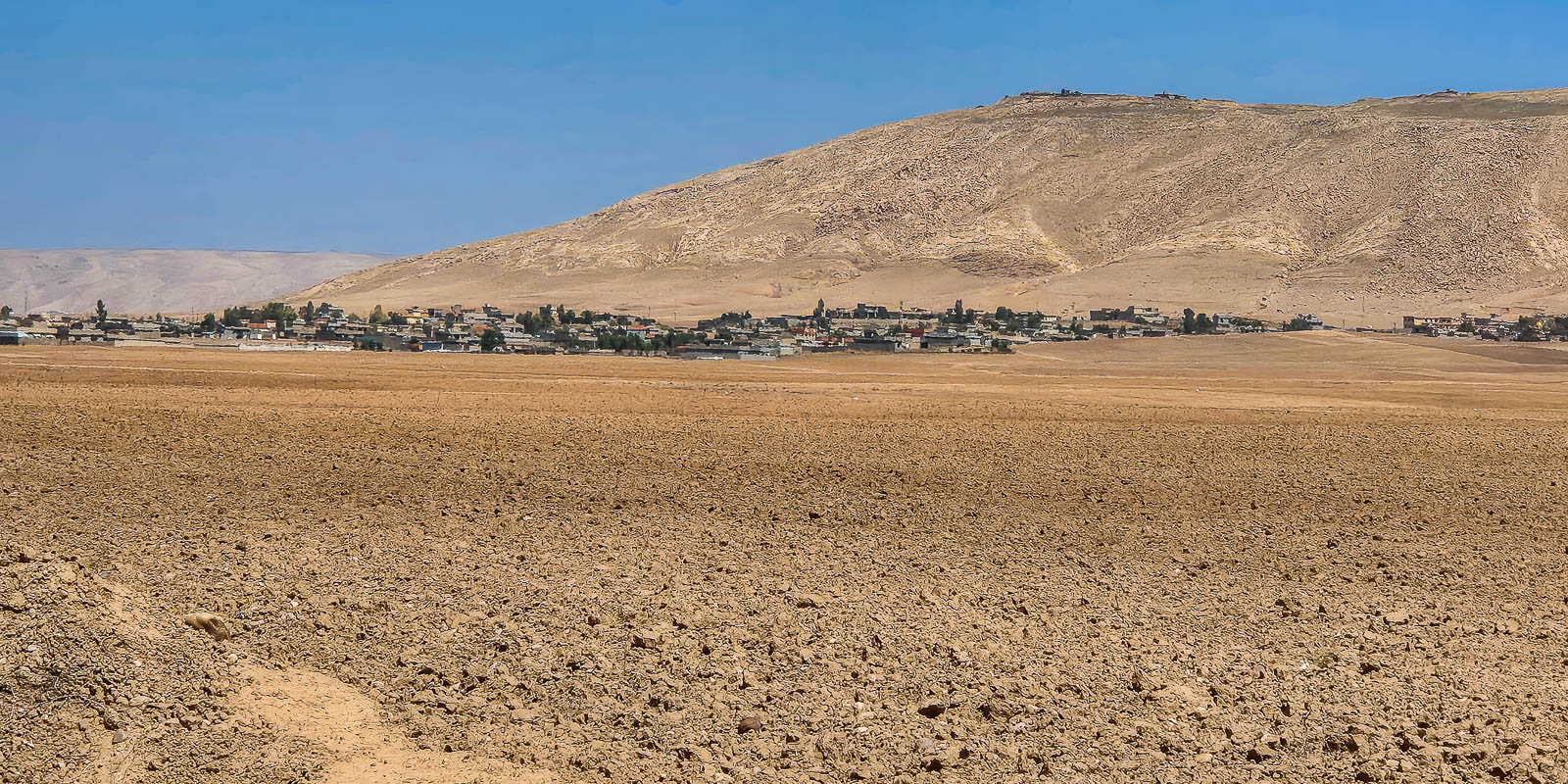


Here, at the monastery, we also meet Iraqi Christians. On the one hand, Christians who are still living in Iraq, but also Christians who have emigrated from Iraq and are now visiting their old homeland. It is moving to listen to them and I don’t think we can imagine what it means to have to live in an area overrun by Islam. In any case, the believers are very friendly and happy to make contact.


Witnesses of the Assyrian Empire
From the Mor Mattai monastery, we drive through a picturesque and very fertile landscape. Cows graze on lush meadows and the whole wide valley is green. We didn’t expect that here and we are delighted by this fertility.
No wonder, as the “Nahr al Khazir” river runs through this area, a tributary of the large “Zab” river.


Jerwan Dam
The aqueduct is part of the larger Atrush Canal, which was built between 703 and 690 BC by the Assyrian king Sanherib to irrigate the extensive gardens of Nineveh, diverting water from the Khenis Gorge 50 km to the north.
An inscription on the aqueduct reads:
“Sennacherib, king of the world, king of Assyria. Over a great distance I had a watercourse diverted to the surroundings of Nineveh to connect the waters … Across steep valleys I spanned an aqueduct of white limestone blocks, over which I made these waters flow.”


Assyrian reliefs from Khinnis
We drive along a country road through a sparsely populated, beautiful landscape and finally reach Khinnis.
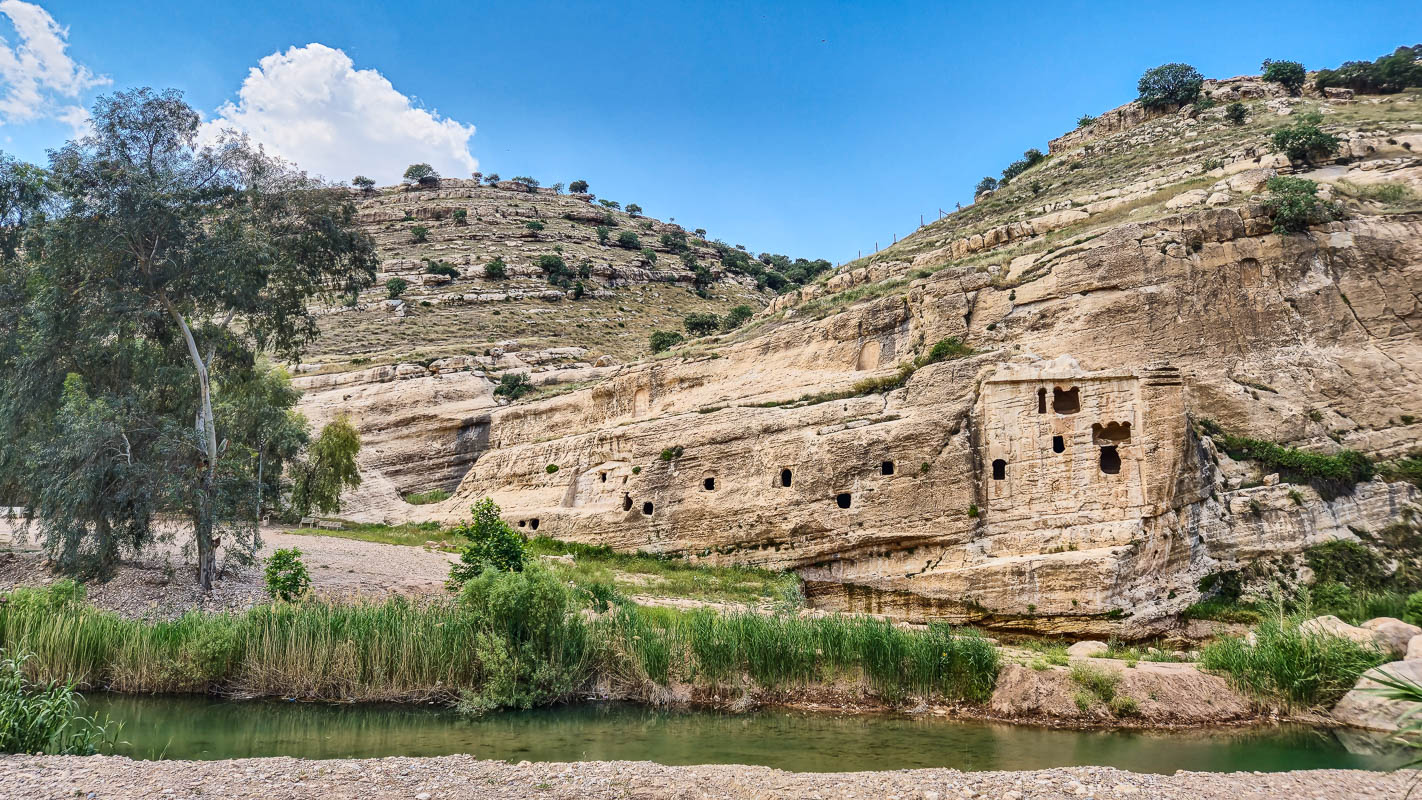
Khinnis is an Assyrian archaeological site in the Kurdistan Region of Iraq. It is known for its rock reliefs, which were built around 690 BC by King Sanherib. It was later used as a hermitage, which was used by monks of the Church of the East in ancient times.
During the reign of Sennacherib (705-681 BC), Khinnis was built to “celebrate the construction of a complex canal system whose aim was to supply the capital of the empire, Nineveh, and its hinterland with water”. The reliefs face the river Gomel and an inscription tells of the construction of a water system built by Sennacherib. The construction of the monument therefore served propaganda purposes for the Assyrian king.




Visit to the Yazidis
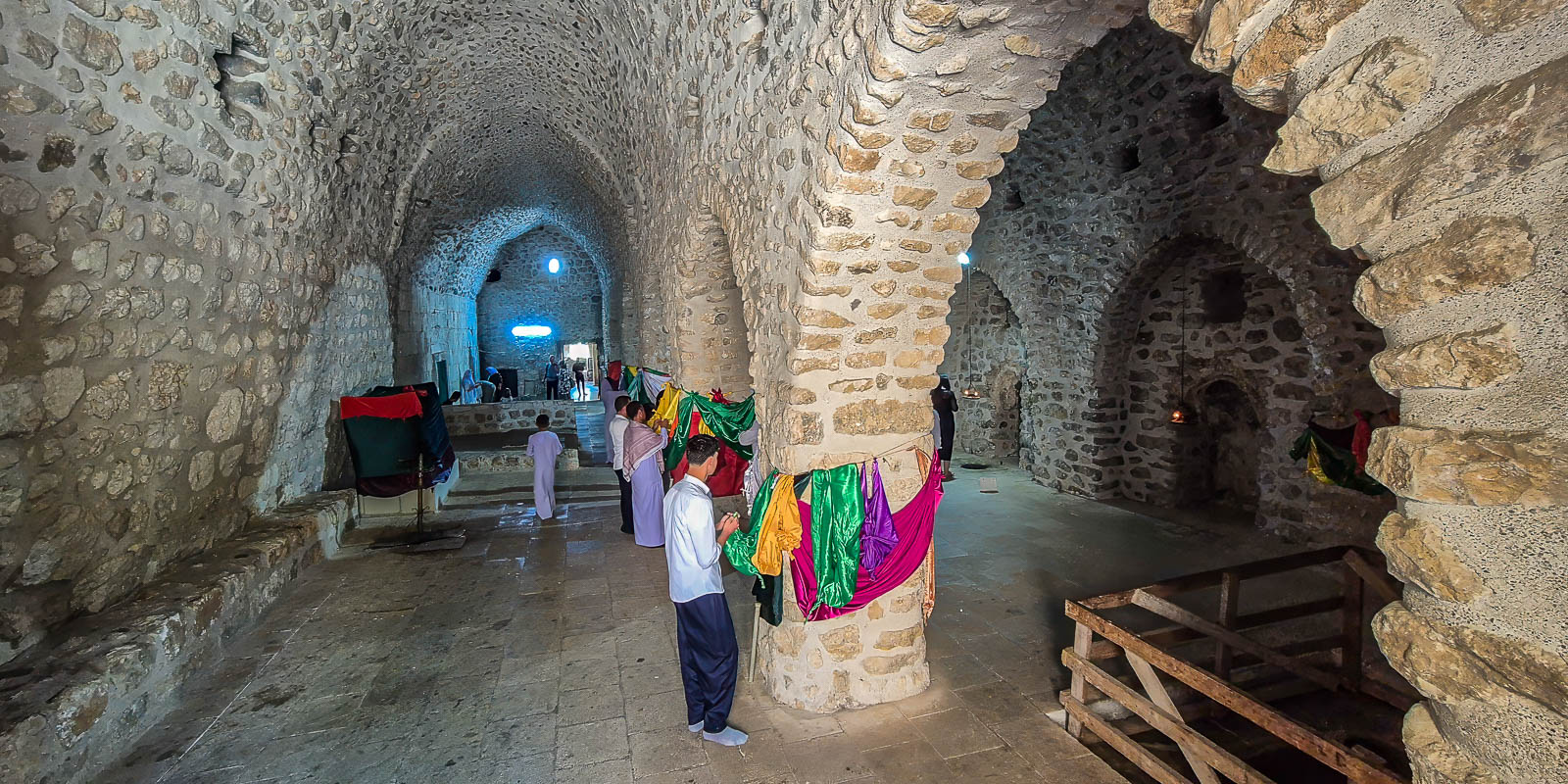
Today, Friday, we drive to Lalish, the center of the Yazidi faith. Tourists are allowed to visit the small village with its Yazidi temple and are often invited for lunch.
The Yazidis are an ethnic-religious minority in northern Iraq, whose homeland is the Sinjar region. Since the genocide by IS from 2014, many Yazidis have been living in refugee camps, their home villages have been destroyed and they continue to face discrimination and insecurity. International efforts are concentrating on reconstruction and support for return, while the focus is on recognizing the crimes and searching for missing persons.
Yazidism is a monotheistic religion that originated over 4,000 years ago in Mesopotamia. Yazidi society is divided into three castes, and marriages are only permitted within one’s own caste or religious community.
From 2014, IS attacked the Sinjar region, murdered thousands of Yazidi men, abducted women and girls as sex slaves and forced boys to fight as child soldiers.
The home region was largely destroyed; Many Yazidis still live in refugee camps today, often under very difficult conditions. The region is unstable, with the presence of various militias, which makes it difficult to return. There are still reports of everyday discrimination and being called “devil worshippers”.




Journey to the Turkish border


